Mining
Mining
The core crushing strategy for metal mining operations is built on the industry-accepted principle of “more crushing, less grinding,” supported by stage-by-stage reduction, closed-circuit screening, and precise product size control. The primary objective is to progressively reduce run-of-mine (ROM) ore from underground or open-pit extraction to a feed size suitable for the grinding circuit, thereby lowering downstream energy consumption and improving overall mineral processing efficiency. Currently, the mainstream and proven solution for metal mines (iron, copper, lead-zinc, manganese, etc.) is the three-stage, one-closed-circuit crushing flowsheet; small to medium-sized mines may adopt a two-stage, one-closed-circuit arrangement, while large-scale, high-capacity operations are typically equipped with the three-stage closed circuit configuration as standard.
修复4 1
Overall Process Flow Framework
  1. Run-of-mine stockpile

  2. Pre-treatment
    for impurity removal

  3. Uniform feeding via
    vibrating feeder

  4. Primary crushing

  5. Pre-screening

  6. Secondary crushing

  7. Tertiary crushing

  8. Closed circuit screening
    and circulation

  9. Qualified crushed ore
    conveyed to mill feed bin
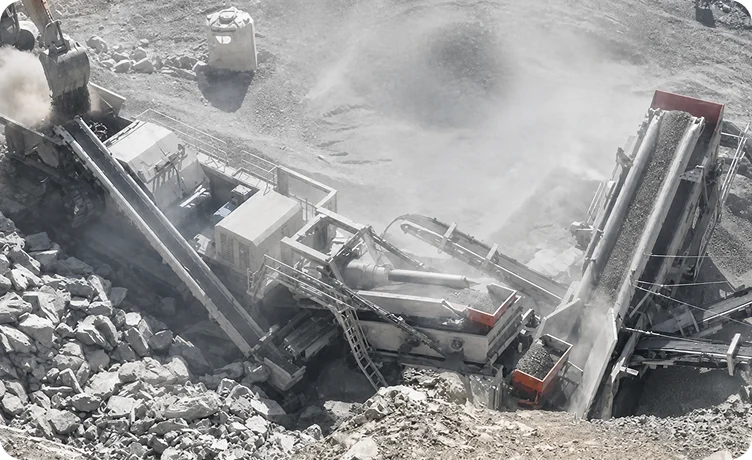
Detailed Process, Parameters, and Equipment Configuration
Metal ores are predominantly hard and abrasive, with high compressive strength. Throughout the crushing circuit, compression-type crushers are employed as the primary equipment, operating on a progressive reduction logic to avoid overloading, poor particle shape, and excessive fines generation that would result from attempting to achieve final size in a single step.
Dfcf2d70 2b1c 45d0 878a 52561470d6d3 1
Our process for marking the process
Slide to view
01
Primary Crushing (Coarse Reduction)
Core Function: To process large ROM ore, break down its loose structure, and reduce particle size to meet the feeding requirements of downstream conveyors and secondary crushers.
Equipment Selection:
Large open-pit metal mines: Gyratory crusher - offering high throughput (2000-8000 t/h), stable continuous operation, and suitability for extra-large feed blocks.
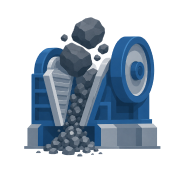
Small to medium-sized underground mines: Jaw crusher - featuring a simple structure, impact resistance, and low operating and maintenance costs, ideal for conventional large ore blocks.
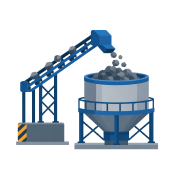
Supporting Steps: Material is uniformly fed into the primary crusher via a vibrating feeder; the crushed product is then conveyed by belt conveyor to an intermediate surge bin or to the pre-screening equipment.
02
Secondary Crushing (Intermediate Reduction)
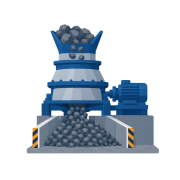
Core Function: To further reduce the primary-crushed material, decrease particle size, and relieve the load on the tertiary stage, while ensuing uniformity of feed size. Equipment Selection: Standard-head hydraulic cone crusher - designed for hard metal ores, offering a high reduction ratio, well-shaped product, strong wear resistance, and continuous stable operation; it is the preferred choice for secondary crushing in metal mining.
03
Tertiary Crushing (Fine Reduction)
Core Function: To crush the secondary product down to the required mill feed size, serving as the critical stage for controlling final product fineness, which directly impacts mill throughput and energy consumption.
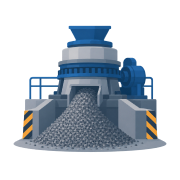
Equipment Selection: Short-head hydraulic cone crusher - featuring a compact crushing chamber, fine discharge size, and high classification precision, ideally suited for the fine-crushing demands of metal ores.
04
Closed-Circuit Screening & Recirculation (Key Closed-Loop Stage)
This is the pivotal element of the three-stage, one-closed-circuit process, ensuring that oversized particles are recirculated and crushed repeatedly until they reach the target size.
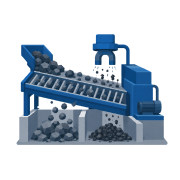
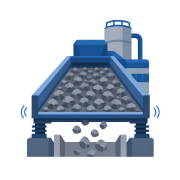
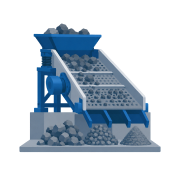
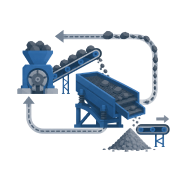
Operational Sequence: Combined discharge from secondary and tertiary crushers → fed to a circular vibrating screen for classification:
Undersize (qualified material): Conveyed by belt to the mill feed bin for storage.
Oversize material: Returned via recirculating conveyor to the tertiary crusher feed opening for re-crushing, repeating the cycle.
Comparison of Two Crushing Process Configurations
Option 1

Three-Stage, One-Closed-Circuit Crushing (Mainstream Standard)

Applicable Scenarios: Large and medium-sized metal mines, with uneven feed size, high capacity demands (≥500 t/h), and strict mill feed size requirements; suitable for hard rock metal ores such as iron, copper, molybdenum, and tungsten.
Advantages: High overall reduction ratio, uniform product size, stable production, low operating and maintenance costs, and optimal realization of the “more crushing, less grinding” principle, significantly reducing both power consumption and steel wear in the grinding stage.
Disadvantages: Requires more equipment, larger footprint, and higher initial capital investment.
Option 2

Three-Stage, One-Closed-Circuit Crushing (Mainstream Standard)

Applicable Scenarios: Small-scale metal mines with capacity below 500 t/h, relatively small feed blocks, and medium-hardness ores.
Process Flow: Primary crushing (jaw crusher) → Secondary crushing (cone crusher) → Closed-circuit screening recirculation.
Advantages: Simplified flowsheet, compact footprint, lower investment, and easy operation.
Disadvantages: Limited adjustment range of product size; less effective for high-hardness ores; lower maximum capacity.