
Construction & Demolition (C&D) Waste
Construction & Demolition (C&D) Waste
The C&D waste processing line follows a sequence of pre-sorting, contaminant removal, staged crushing, and closed-loop screening. After initial impurities are removed, the material is evenly fed into a jaw crusher for primary crushing. Magnetic separation and manual sorting then remove ferrous metals, plastics, wood, and other light contaminants. The cleaned material enters an impact crusher for secondary crushing and shaping, followed by vibrating screening. Oversized material is returned for re-crushing, while air classification further removes light impurities, producing clean, multi-graded recycled aggregates.
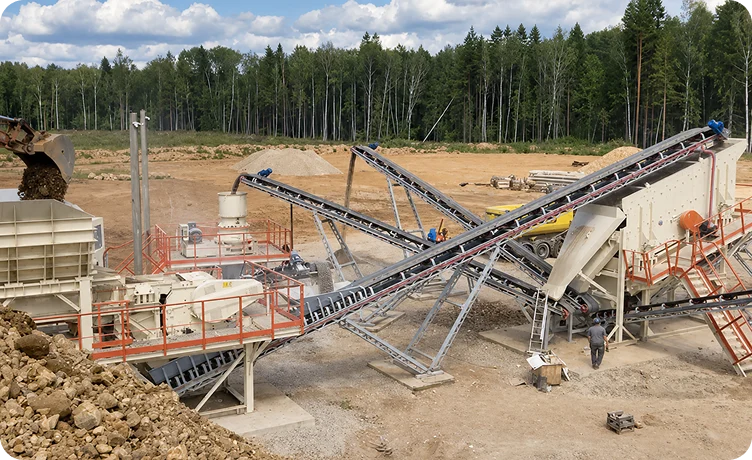
Our process for marking the process
Slide to view
01
Pre-treatment & Sorting
Upon arrival at the site, the C&D waste undergoes an initial manual sort to remove bulky impurities such as timber, plastics, fabric strips, packaging materials, household refuse, and other non-crushable hard objects. A wheel loader is used for stockpile sorting to eliminate oversized steel bars, steel pipes, iron pieces, and other materials that could damage equipment, thereby reducing the risk of breakdowns and ensuring stable crushing operations. Surface soil is also removed during this stage to minimize the clay content in the final product.
02
Feeding & Conveying
The pre-sorted material is fed into a vibrating feeder, which delivers a uniform and metered flow. A grizzly feeder is recommended, as its built-in pre-screening function effectively scalps out fine soil and powdery impurities in advance, preventing the accumulation of fines that could hinder crushing efficiency, and ensuring steady and even feeding.
03
Primary Crushing
The material enters a jaw crusher for primary reduction, where large concrete blocks, red bricks, and other hard components are broken down to a size suitable for downstream secondary crushing equipment.
04
Magnetic Separation & Impurity Removal
After primary crushing, the material is transported along a belt conveyor, above which a suspended, high-intensity magnetic separator automatically attracts and removes residual steel bars, wire, iron filings, and other ferrous contaminants. This prevents metal from entering the secondary crusher, where it could cause wear, jamming, or damage, while also enhancing the purity of the final recycled aggregates. The recovered scrap metal is collected separately for recycling.
05
Manual Sorting Station
Following magnetic separation, a manual sorting station is positioned alongside the conveyor belt, staffed by dedicated personnel for secondary fine picking. This step focuses on removing any remaining light and inert impurities, including plastic fragments, wood chips, fabric strips, rubber, glass, and hardened clay lumps, as well as any overlooked fine metal residues or excessively hard foreign objects.
06
Secondary Crushing & Shaping
The manually inspected material is fed into an impact crusher for secondary crushing and particle shaping. This stage performs fine comminution on the primary crushed product, and the discharge gap can be adjusted according to the required finished particle size.
07
Closed-Circuit Screening
The secondary crushed material is delivered to a multi-deck vibrating screen for classification by particle size. Materials that meet the required specifications are separated as finished products; any oversized particles are returned via a recirculating belt conveyor to the impact crusher for re-crushing, forming a closed-loop circulation.
08
Air Classification for Deep Impurity Removal
The screened aggregates pass through an air classification system, which precisely separates residual light impurities such as wood dust, plastic chips, and fine dust. This further enhances the cleanliness of the final recycled aggregates to meet high-quality standards for recycled materials, while also reducing dust dispersion in the working area.
09
Finished Product Stockpiling & Dispatch
The classified, qualified recycled aggregates of various sizes are independently conveyed by belt conveyors to designated finished product bins, where they are stored separately by grade and category, ready for timely dispatch.