
Sand & Gravel Aggregates
Sand Making & Shaping
This process is engineered for the precision production and particle shaping of crushed aggregates, targeting common quality defects found in manufactured sand, such as excessive angularity, high flakiness index, poor gradation, unstable filler content, and elevated crushing value. Operating in a continuous, closed-loop, low-loss manner, the system yields finished sand with well-rounded particles, consistent gradation, and stable performance indicators that fully comply with construction sand specifications.
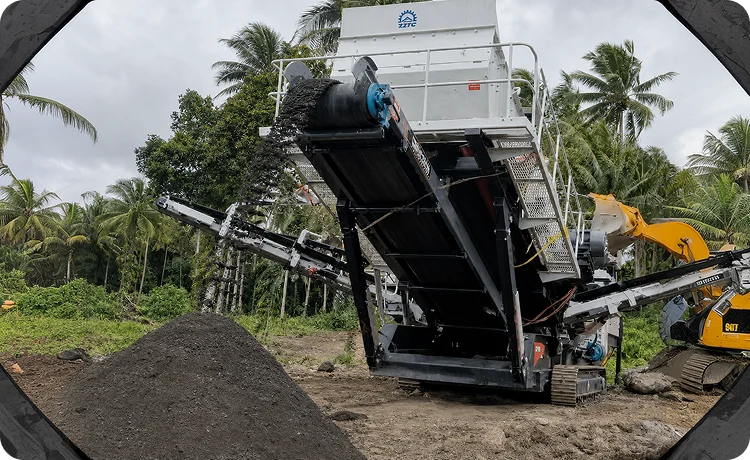
Our process for marking the process
Slide to view
01
Uniform Feeding and Pre-Screening
Qualified feed material is fed into a vibrating feeder to ensure a continuous, even, and metered flow. When equipped with a grizzly feeder, the feeder can scalp out fine fractions, effectively reducing wear on primary crushing equipment and improving overall crushing efficiency.
02
Primary Crushing (Jaw Crusher)
The feed material is initially reduced in a jaw crusher, producing a uniformly graded coarse aggregate that provides a consistent foundation for the subsequent secondary crushing and sand-making stages.
03
Secondary Crushing (Graded Crushing)
The secondary crusher is selected based on material hardness: impact crushers are preferred for medium-hard rocks such as limestone and shale, while cone crushers are used for hard rocks like granite and basalt. This stage processes the coarse material into medium-sized, uniform aggregates, delivering a qualified feed for the sand-making and shaping step.
04
Sand Manufacturing & Shaping (VSI Crusher)
The medium aggregate is fed into a VSI Crusher, which employs the “rock-on-rock” crushing principle to achieve both fine comminution and particle shaping. Through high-speed impact and inter-particle attrition, sharp edges are eliminated and the particle shape is optimized, while ensuring that the basic gradation meets specifications. This is the core step in enhancing the quality of manufactured sand.
05
Multi-Stage Screening and Closed-Loop Recirculation
The crushed mixture is then conveyed to a vibrating screen for precise classification. Oversized materials are fully returned via a recirculating conveyor system to the VSI crusher for re-crushing and further shaping, forming a closed-loop production cycle.
06
Finished Product Purification (Process-Specific)
Dry Process: Equipped with a variable-frequency air classifier and pulse-jet baghouse filter, the system accurately separates excess stone powder from the finished sand, dynamically regulating the powder content to meet national standards. All collected dust is uniformly stored for resource recovery, with zero wastewater generated throughout the process.
Wet Process: The material passes through a wheel or spiral sand washer, where circulating water removes surface clay and impurities, effectively lowering the clay content. The washed sand is then dewatered on a dewatering screen, producing a finished manufactured sand that meets application requirements.
Sand & Gravel Aggregates
The aggregates production line is designed around the core principles of pre-screening and staged crushing, employing a closed-loop material circulation model to minimize waste. Strict practices are enforced for grading, classifying, and stockpiling in designated zones to control quality from the source. A two-stage crushing process is adopted, with equipment selection tailored to rock lithology: jaw crusher + cone crusher for hard rocks, and jaw crusher + impact crusher for soft rocks, striking an optimal balance between crushing efficiency and finished aggregate particle shape.
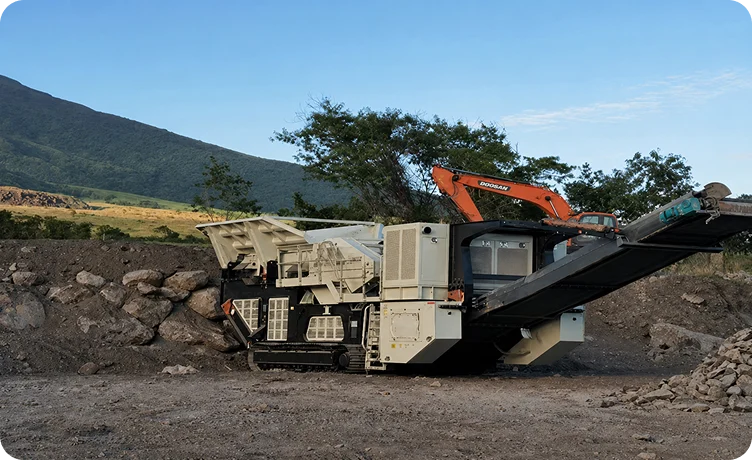
Our process for marking the process
Slide to view
01
Raw Material Pre-treatment & Scalping
Qualified large-sized material is fed continuously, evenly, and in metered amounts using an apron feeder or vibrating feeder at the site.
02
Primary Crushing
The large raw stones are fed into a jaw crusher for primary crushing. The discharged material is then conveyed via belt conveyor to an intermediate surge hopper, which effectively buffers material flow, smoothing out fluctuations and preventing feed interruptions or blockages in downstream operations.
03
Secondary Crushing
The medium-sized stones from the surge hopper are uniformly fed into secondary crushers, with precise selection based on rock characteristics:
Cone crushers are chosen for hard, abrasive rocks such as granite and basalt, offering low wear costs and high operational stability.
Impact crushers are used for softer ores like limestone and dolomite, producing well-shaped aggregates with minimal fines generation.
Oversized fractions are returned to the crusher via a closed-loop recirculation system for further reduction.
04
Sand Making & Shaping
A portion of the intermediate aggregate is directed to a VSI crusher, which employs the “rock-on-rock” crushing principle to produce manufactured sand while effectively improving particle shape and reducing flakiness. The resulting aggregates exhibit good sphericity, continuous and uniform gradation, and significantly enhanced compressive strength, meeting the stringent requirements of premium concrete, municipal road construction, and hydraulic engineering projects.
05
Screening, Washing, and Fine Sand Recovery
A multi-deck vibrating screen classifies the crushed mixture into finished sizes. On-spec products are conveyed to stockpiles, while oversized materials are returned via recirculating conveyors to the crusher for re-crushing, forming a fully closed-loop circuit with zero waste generation.
In wet or semi-wet processes, the screened manufactured sand is thoroughly washed in a sand washer to remove surface-adhering clay and impurities, ensuring cleanliness compliance.
In dry processes, stone powder content is precisely regulated by integrated dust collection equipment, meeting standards without the need of washing.
A fine sand recovery unit is incorporated in the washing stage to efficiently capture fine sand particles lost in the wastewater; the recovered fines are blended back into the finished sand, improving raw material utilization and reducing resource loss and water pollution.
06
Finished Product Stockpiling, Dewatering, and
Dispatch
The screened qualified aggregates of various sizes are separately conveyed via belt conveyors to independent finished product bins for stockpiling in designated zones.