
Mobile Crushing
Mobile Crushing
Driven by the combined pressures of multi-site crushing operations, solid waste recycling, space-constrained job sites, and rising transport costs, on-site crushing with rapid relocation and quick commissioning has become an essential requirement for a growing number of projects. Mobile crushing equipment, with its core advantages of flexible deployment, elimination of civil works, and reduced haulage costs, is ideally suited for mobile aggregate processing, C&D waste recycling, tunnel muck utilization, and small-scale mining operations. However, equipment selection must still be evaluated holistically against project duration, transport distance, and throughput capacity, to differentiate between mobile solutions and fixed crushing lines.
Our process for marking the process
Slide to view
01
Undercarriage Selection
Tracked mobile crushing plants: The preferred choice for frequent relocations, mountainous or muddy terrain, unhardened sites, remote outdoor operations, and high-altitude or low temperature environments. They are self-propelled and require no towing, offering exceptional adaptability for temporary construction projects and remote mining applications.
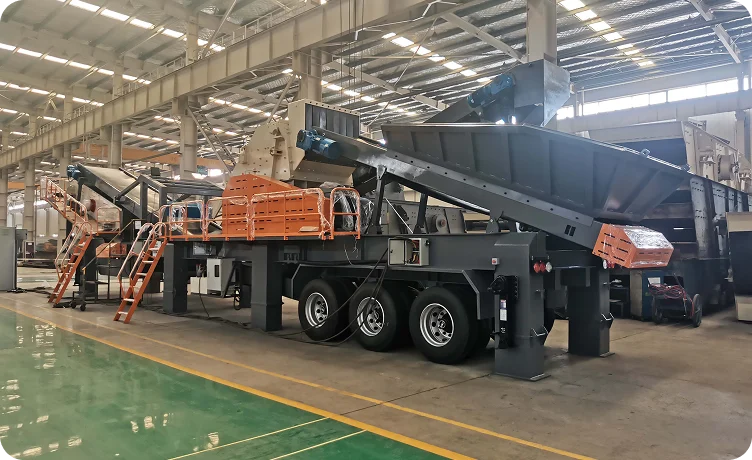
Tyre-mounted mobile crushing plants: Suited for flat plant sites, fixed operational zones, short-term projects, and short distance relocations. They feature lower equipment costs and faster transfer speeds, rely on tractor-trailer towing, and are ideal for urban demolition and fixed aggregate processing sites.
02
Core Crushing Unit Selection
Jaw-type mobile crushing unit (dedicated to primary crushing): A versatile coarse crusher with a large feed opening and high compressive resistance, suitable for primary reduction of materials of all hardness levels. It processes large feed blocks into medium-sized semi-finished products and serves as the essential first stage in all process routes.
Impact-type mobile crushing unit (dedicated to fine crushing): Designed for soft to medium-hard materials, producing well-graded, cubical product with low flakiness content. It is primarily used for aggregate shaping and fine crushing, but is not suitable for highly hard and abrasive materials, which could cause rapid wear of wear parts.
Cone-type mobile crushing unit (dedicated to hard-rock fine crushing): Engineered for high-hardness rocks, employing a compression-type crushing mechanism with low wear, stable throughput, and low failure rates. It is the core equipment for high-grade hard-rock aggregate fine crushing and can sustain high-intensity continuous operations.
03
Screening and Auxiliary Equipment Selection
Mobile screening units: Depending on product size requirements, two-deck or three-deck vibrating screens can be selected, capable of producing 3-4 different finished fractions simultaneously. For applications requiring recirculation, a return conveyor is incorporated to achieve closed-loop crushing.
Supporting auxiliary equipment:
For C&D waste applications, a magnetic separator is mandatory to extract rebar and steel scrap.
In areas with strict dust control, an integrated spraying + baghouse dust collector system is recommended.
Where mains power is unavailable, a diesel generator set can be supplied.
For materials with high clay content, a pre-screening feeder is recommended ahead of the primary crusher.